The Good Earth
This is the sermon preached by Rev. Dr. Don Van Antwerpe to the congregation of Unfinished Community on Sunday, July 26, 2026, drawing from Matthew 13:1-9, 18-23 and Psalm 119:129-136
I have a bad habit of getting, for lack of a better term, extraordinarily sassy when faced with difficult times, especially if I feel, in my heart of hearts, that said difficulties are not my fault. And while this tendency can be in some respects a boon for a preacher - I am, for example, never short of a sharp word to power and privilege, the holders of which being the source of a great deal of difficulty for myself and many others - it can also be a notable problem for me as well, especially interpersonally.
Being quick with the tongue cuts both ways, one might strain the metaphor to say.
So my instinct this week was, honestly, to pick up where I left off last week, and to heap divinely-inspired criticism, even judgement, upon those who have caused me, and many others, great difficulty in recent times. This is, of course, the temptation of the pulpit; its power, and its weakness. When you stand in this space - physically, or in my case somewhat more metaphorically - it is very easy to mistake the message you have been called to bring for your own, to mistake the power for your own.
But this space…isn’t my space. It’s God’s space.
Which is why, as a matter of spiritual discipline, whenever I find that the message which jumps to my heart is suspiciously in line with my own angers, irritations, and yes prejudices, I immediately stop, pray, and ask myself that first question that every preacher should ask themselves.
What is God saying, right now, today?
I know many of us are used to hearing questions like this with kind of schizophrenic overtones, so I want to be clear that I’m not suggesting that we all listen for voices in our heads, or anything like that. In my experience, God rarely speaks in such bluntly direct ways. God is impossibly, infinitely larger than any one of us - definitionally so, in fact - which means that in times when our own personal situation is overwhelming our personal ability to discern the presence of God, we need to just back off a bit; to pull back, and look for the presence of God, to look for the message of God, on a larger scale, in a larger context.
Today’s main scripture, the parable of the sower, is one of those texts that is really easy to just absolutely hurl at somebody you’re pissed off at. It’s easy to call others bad seed, or bird food, to say that they have no “depth of soil,” or to envision them being choked to death by a brace of growing, grasping thorns. And at the same time it’s easy to take from the message of the different types of scattered seed that hyper-capitalist sentiment that all ministry, indeed everything we do, has to be measured solely by results. That if what we do struggles, or even fails, that if challenges present, then it was because we were seed sown in improper ground. That we, to paraphrase the last one of the three brothers left standing, chose poorly.
We get angry at the infertile ground of our lives, angry at the thorns, angry at the crows, and angry at all those other stalks of grain, reaching towards the sky when we’re still struggling to push through a crack in the pavement.
And we blame ourselves for failing to grow.
But when we do that, we miss the key message of Jesus’ parable, a message that is based not in the results of the sower’s sowing, but in the act of sowing itself. Where is the agency in this parable, who is it who makes the choice as to where and how the seeds should fall? It isn’t the seeds, it’s the sower. Now before we jump to the common, and I’ll admit very understandable, tendency to start blaming God for all our struggles, I would like to offer us a bit of perspective,
Birds need to eat too.
When Jesus goes to explain the passage later on, he describes the seed snatched away by birds as “the evil one” snatching away the seed before it can be sown in the heart, But “the evil one” here, if we look to the Greek, isn’t satanos (that is, “Satan,” or “the tempter”) or any other literary figure we see in the Bible and generally associate with “the devil.” No, instead what we’re given here is πονηρὸς (poneros), a word which here is something of an anthropomorphic presentation of an adjective which describes something as being “full of labors, annoyances, or hardships.” As such, what we have here isn’t somebody who’s being “blocked from the word by the devil,” as an American evangelical might say, but someone so overburdened by hardship, someone forced into constant labor and perpetual annoyance, to the point where their lives are so filled with stress and fear that there’s no place for God’s word of mercy, love, and above all justice to take root.
But, of course, birds need to eat too. So the seeds sewn on the path might not take root right where they were planted, because…well…they’re going for a ride. But birds don’t usually metabolize all the seeds they eat. Some of them survive, come out the other end, and find themselves back on the ground again in an entirely different place than where they were first set, and covered in a generous amount of fertilizer on top. And in this new place, off the beaten path, they’ll grow even taller than they did before those hardships scooped them up. And it wasn’t the sower’s fault, and it wasn’t the bird’s fault; those seeds just served a different purpose.
But what about those sown on rocky ground?
Well, as Jesus himself points out in the passage, those sown on rocky ground receive first with joy, but are unable to take root and thus their joy crumbles when the slightest difficulty comes. This is true enough, to be sure….but that is only the first part of the story. Sure, it’s much harder for seeds to sprout in rocky ground, but it’s not impossible. And when that first seed grows, and crumbles, it falls back into the soil to nourish it, possibly having produced a few seeds of its own. And if enough seeds fall or are formed over rocky ground, the soil itself begins to change until eventually, something does take root. Oh, it may just be a single wheat stalk pushing up among the rocks, like a dandelion pushing itself through a crack in the pavement, but it’s enough for the sower to take notice, and to see that ground which he once thought infertile maybe isn’t as infertile as he thought. A sower of seed who sees fertile ground covered with rocks will naturally take some time to remove those rocks, and increase the amount of usable land available. In time, and with patience, even rocky ground can become fertile.
Thorns are a different thing though, right?
Notwithstanding the rather obvious fact that even thorns have their purposes, otherwise there would be no roses, thorns and thistles are a nightmare for the intentional sower of seed. As the passage well states, they grow up and choke out anything else around them, while producing very little of any real value, especially to the farmer looking to grow wheat specifically. Thorns and thistles require very fertile soil, and good resource, to grow as they do, so it’s not especially common for seed to fall among thorns, because any decent farmer would have cleared those out long before sowing seed. So what we have to be talking about here is not a known thistle patch, but something that sprung up; an invasive patch of thorns and thistles that wasn’t really there when the sower first laid down seed.
So…any seed that falls into that space, and gets choked out by rapidly growing thorns, might not grow very much itself. But the farmer is going to take notice, and come back with a flamethrower to deal with the thistle problem before it chokes out everything else too.
So what does it all mean?
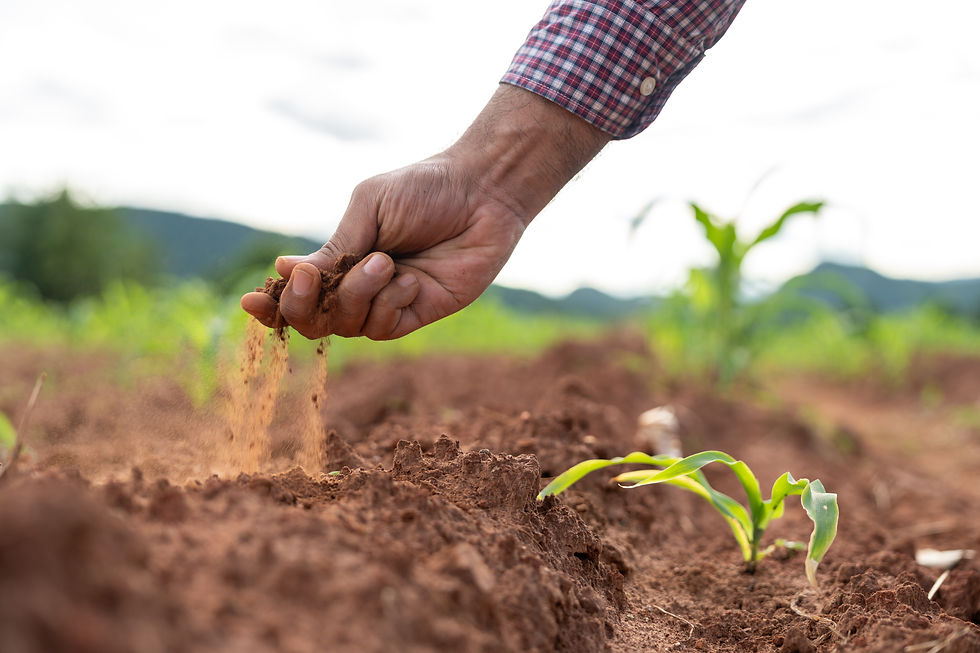
In the end, God works through all things for the good of those who love God. Whether we find ourselves on the path, among the rocks, or being choked out by thorns and thistles in the moment doesn’t change the fact that the sower of the seeds is still hard at work. The story of a seed doesn’t stop the minute it leaves the farmer’s hand. He comes back constantly to water it, to tend it, to pull up rocks, to burn away the thistles, and to fend off the birds. But in the parable here, it is important to remember that we aren’t the seed; we are the ones responsible for the soil.
Our job, in our own hearts, is to take care of the soil, to pull up the weeds, to chase off the birds, sweep up the path, dig up the rocks, and burn away the thistles, so that the seed we are given can take root deeply, grow tall, and produce good fruit. Many of the seeds we are given to plant do this with very little work. For example, I imagine that most, if not all, of you have taken God’s commandment to not commit murder very well to heart. I’m betting most of you don’t really steal either, for that matter. But as times get tougher, and the justifications start to sound more convincing, the soil gets drier and the growing, well it gets rough. “You shall not commit adultery,” for example, isn’t nearly as well-kept as the others, to say nothing of coveting your neighbor’s spouse. And then there’s all the littler seeds, all the infinite facets of God’s love which are just waiting to take root, but which require an open mind, an open heart, and the determination and willpower to do the right thing rather than to just….let the thistles win; the angry snap at an overexcited kid, for example, who was just excited to be there, or the dismissal of a loved one’s suffering because you’re too tired to care, the submission to fear because you’re so worried about the bad that could happen in the future that you can’t invest in the good that should happen now. We make those little compromises, let the rocks lie, or the thistles grow, and before we know it our seeds are scattered, but our fields are barren and dry.
What happened?
We failed to till that good earth. We failed to trim the verge, push back the thorns, dig up the rocks, and make room in our hearts for the seeds of God’s word to drink deep, take root, and grow beautiful fruit within us.
Being a good, fruit-bearing Christian takes effort. Deliberate, intentional, effort. It is not the result of good fundraising, the building of buildings, social networking, good video editing, marketing, or even the preaching of good and dramatic sermons. The work of the Lord is done in the small moments, when we are given the chance to do the good and loving thing, and we do it rather than taking the easier, less loving way.
The way of Christ is in a child hugged rather than scolded, in tears embraced and uplifted rather than scorned as an inconvenience, in food made and shared without agenda, in a million little acts of friendship, kindness, and love.
That is who we are as followers of Christ, whose law is love and whose gospel is peace. So in our own lives, in our own time, let us come before God with this prayer from Psalm 119, asking God to help us be keepers of this good earth, the soil entrusted to each of us in our own hearts and lives.
Your decrees are wonderful;
therefore my soul keeps them.
The unfolding of your words gives light;
it imparts understanding to the simple.
With open mouth I pant,
because I long for your commandments.
Turn to me and be gracious to me,
as is your custom toward those who love your name.
Keep my steps steady according to your promise,
and never let iniquity have dominion over me.
Redeem me from human oppression,
that I may keep your precepts.
Make your face shine upon your servant,
and teach me your statutes.
My eyes shed streams of tears
because your law is not kept
(Psalm 119:129-136, NRSVUE)


Comments